Anyone following my little journal might be surprised by now at the omission of any mention of a bucket list, that obligatory catalogue of desirous achievements so common among those my age. This practice has always struck me as somewhat ‘pro forma’, like a to-do list that entails methodically checking off items and often posting them to social media in order to publicly affirm that our lives are as fulfilling as they ought to be.
I think of life rather as a bucket of experiences, amazing ones (hopefully), but also mundane and even disappointing ones, for this seems a more realistic expectation of fully engaging in the world around us. Last week, I was reminded of this distinction while attending a company meeting in Geneva, Switzerland, our first get together after 18 months of COVID lockdown. The meeting itself was a blast. We worked hard on our commercial strategy, and I delighted in sharing my experiences as a ‘grizzled veteran’ with my younger co-workers. It didn’t hurt that our evenings were occupied with loud, laughter-filled dinners, facilitated by surprisingly tasty local Swiss wines. (Side note: Lake Geneva is enveloped by vineyards; grapes were cultivated there by the Romans, making it a World Heritage Site.)
But my real excitement was in anticipation of the weekend, for a colleague had invited me to climb one of the famous mountains in the Alps, the Jungfrau (German for maiden or young lady). I’ve never climbed a mountain, but I am an avowed adventurer, so of course I immediately said yes to his kind invitation. And later, I only gave the slightest pause when he sent me a Youtube video which conveyed the seriousness of the endeavor.
On Friday, our group assembled. It consisted of my work friend, his long time climbing buddy from South Africa, my friend’s son and his son’s friend, two strapping young lads with loads of mountaineering experience. In fact, everyone in the group has climbed extensively, and they were extraordinarily gracious to include me, a “climbing Jungfrau”. 🙂
The Jungfrau is the highest of a trio of peaks in the Bernese Alps that, along with the Eiger and Monch, forms one of the world’s most famous mountain climbing trilogies. As with most Alpine assents, you spend the preceding night acclimatizing in a high altitude “hut” and setting out the next morning before dawn. On Saturday afternoon, my friend and I took advantage of our early arrival and perfect weather to take a practice climb up the back side of the Eiger (of North Face fame). We ascended to a ridge, which at 3750 meters elevation sits only 200 meters below the peak. This was my first opportunity to see if I had the right stuff for this adventure: Did I have the physical endurance to trod uphill through ice and snow for hours at a time? Could I master fundamental skills, like maintaining my balance by sinking an ice axe into the opposite side of a 70 degree sloped ridge? Could I keep my wits about me, knowing that one misstep might lead to tragic results? After this “warm up”, I was elated to be able to answer these questions in the affirmative, and my weekend would have been a thrilling success if it had ended right there.
The goal, however, was to climb to the summit of the Jungfrau on Sunday, which began to look questionable as we watched a heavy snow fall develop while having dinner. The psychology of climbers is fascinating. When they talk about attaining a mountain peak, they describe it as an attempt. This isn’t hedging their bets; it’s an acknowledgment that many things can go wrong, and a single one will very likely result in an aborted effort. It’s also a reminder to celebrate the journey no matter the outcome, to be humble and respectful in the face of nature’s magnificent power.
Setting out on Sunday at 4:30 am, it was obvious the weather had taken a turn for the worse. Several inches of snow had fallen overnight, and a chilling wind greeted the day. Mountains, however, are infamous for fast-changing weather conditions (both good and bad), so keeping an optimistic eye on reports, we headed out across the glacier that leads to the base of the Jungfrau.
Before this trip, I’m sure I had heard of the phenomenon of glacial crevasses, but I never fully understood or appreciated exactly what they were. In fact, they are just as they sound – vacant spaces in the ice, potentially dozens of feet deep – avoidable if visible but often covered by snow, making them one of the most treacherous aspects of mountain climbing. Sometimes, going around a crevasse is not as simple as it sounds, as I learned on Sunday. Approaching a particularly daunting gap in the ice, we noted the presence of a snow bridge that looked like it had been crossed on previous days but that we did not trust to support our body weight. This necessitated a traversal using the ice axe and crampons in a ‘crab walk’ maneuver across an extremely steep ice wall around and then above the crevasse. Slipping would have meant relying on the other climbers to catch you via the rope we were all attached to. Thankfully, this safety device went unemployed, but my heart rate monitoring watch must have been curious what I was up to.
Reaching the Jungfrau base proper, we encountered a rocky ridge that requires actual climbing. The first section was manageable, and I was happy to get through it. It was only when we reached the second section that I became acutely aware of how difficult this was going to be. The rock wall in front of us would be challenging under normal conditions, but on this day it was covered with ice, meaning grip could only be attained through the crampons on our boots (look ma, no hands!). One member of the team ascended about 15 meters to a level area (respect!); he then belayed each of us in turn to join him. While the others could all have climbed without the rope, there was no way I could have done that. For them the rope was for safety; for me it was a climbing aid.
In climbing, you are continually making a decision: go forward or turn back. It’s a gut wrenching choice. You might spend months or even years waiting and preparing for this day. How can you come this far only to be denied achieving your dream? But perhaps it’s now clear why climbers define the goal as the attempt, not the summit. Reaching the summit requires many things to be sure: skill, training, desire, courage. But it also requires a measure of luck, notoriously fickle luck.
Standing on that ledge with the weather worsening and assessing our slow progress, we agonized over the decision to go forward or turn around, but all of us knew there was only one real option. Once it was said out loud (by one of the two young men: “let’s live to climb another day”), the spell was broken, and we began our long descent back to camp.
On the train back to Zurich, I had plenty of time to reflect on the previous two, magnificent days. If climbing to a summit in the Alps had been on a bucket list, the weekend would have been in some sense a failure. It was just the opposite. In two days, I learned so much about myself; that I am still up to extreme physical challenges, that I can manage my emotions and perform under risky circumstances. I made great new friends and shared a treasured experience with them. I got to see the exquisite beauty of Switzerland.
And I learned the incredibly important lesson that the wisdom to turn back is just as important as the courage to go forward.

The gorgeous Swiss countryside carved out by glaciers 
Rapeling on the descent 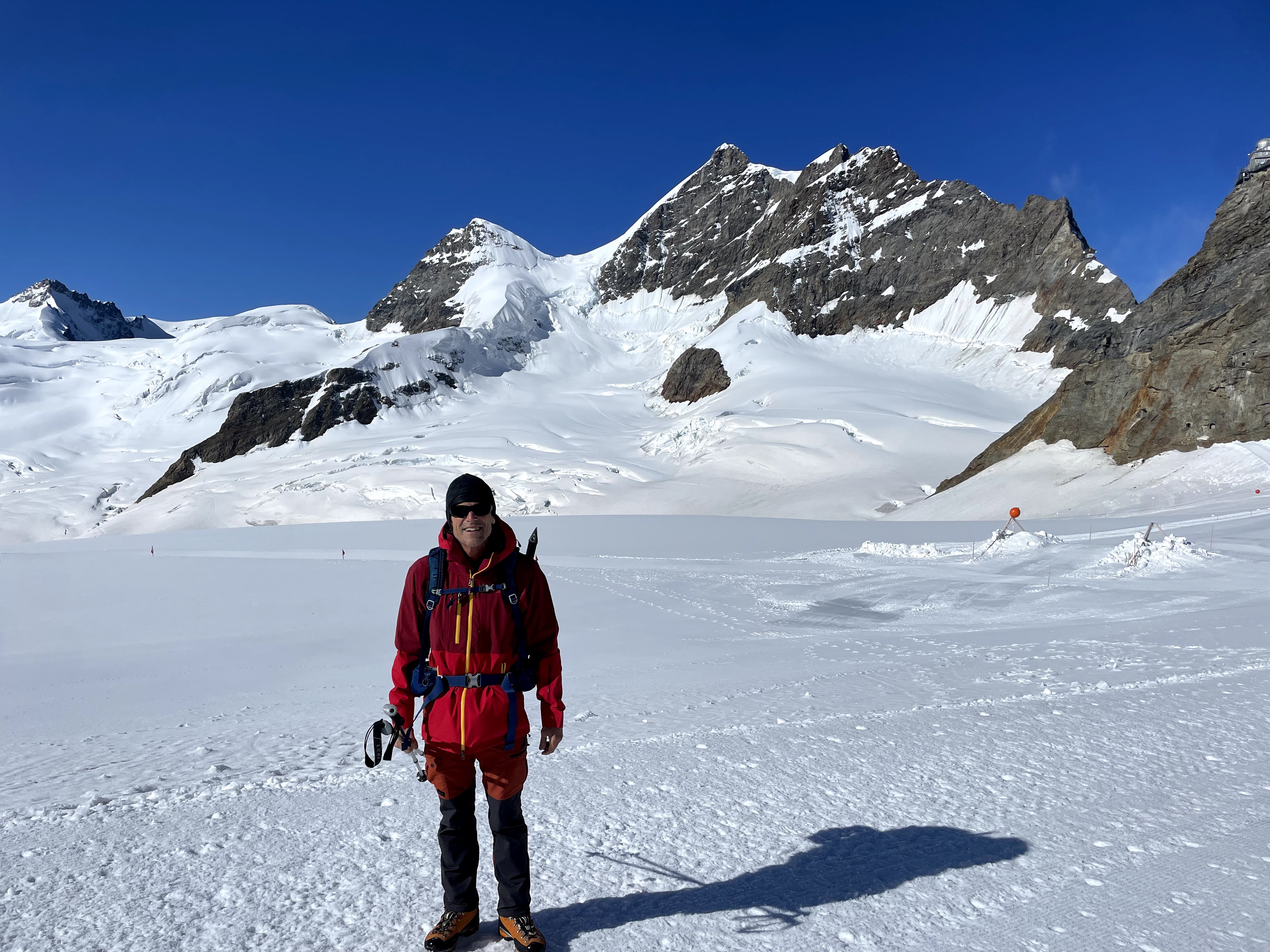
That’s Jungfrau behind me 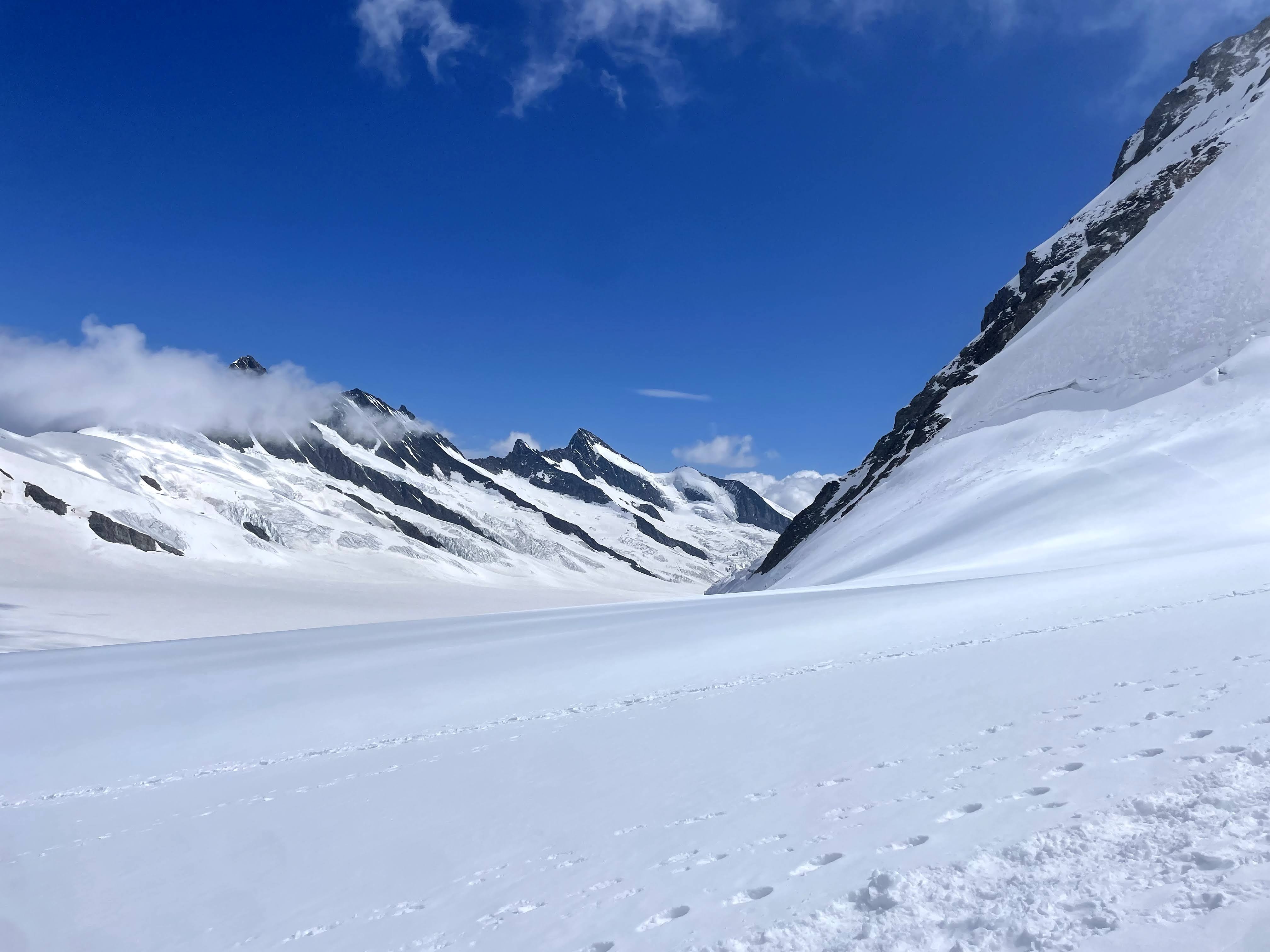

Traversing a ridge on the Eiger 
Those are our footsteps 


The climbing gang happily back at camp 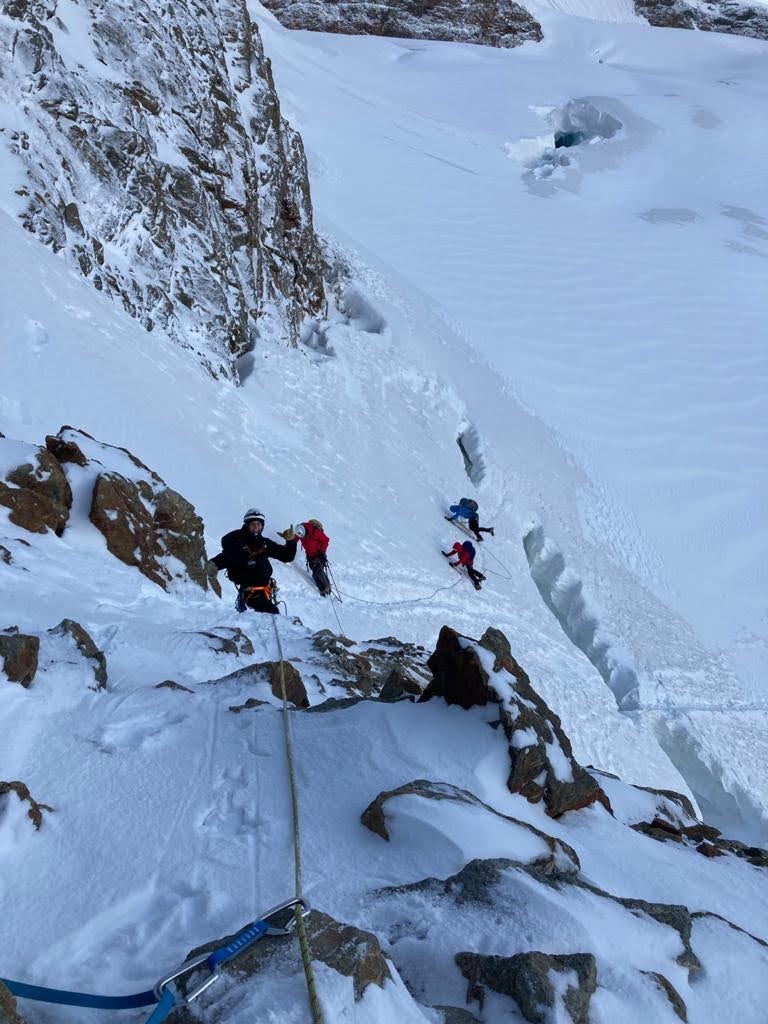
Traversing above the crevasse!
 My 3rd Third
When I hear of a new and interesting thing to do, I hear myself saying “It’s on the list”. There is no list in reality. I like the idea of saying “yes” to as many things as possible, then as you suggest, the journey could take you in any direction – much more interesting. However, in this case, I would have said “no thanks” to your friend…..or perhaps I would have asked if there is something a little less challenging but still challenging enough for me.
LikeLike